latakaranja :
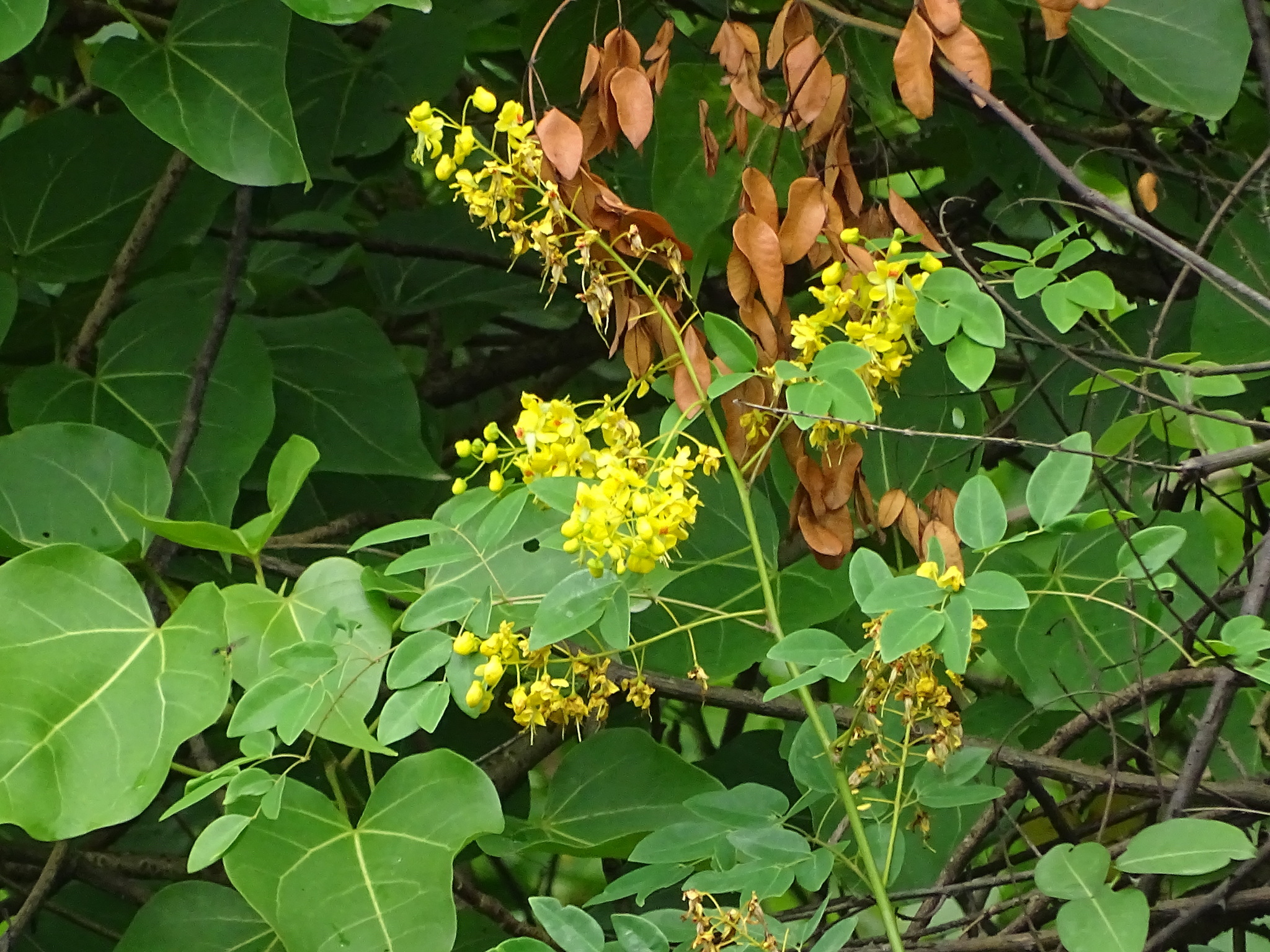
Morphology:
Growth Form: A climber with a scrambling growth form up to 5 to 20m in height and can scramble over tall trees.
Foliage: Its spirally arranged, stalked, bipinnate leaves have about 2–4 pairs of primary leaflets (pinnae) that are up to 8 cm long and each has 1–5 pairs of opposite secondary leaflets (pinnules). Its leathery pinnule blades are egg-shaped to lance-shaped, shining green above, and 2–10 by 1–5 cm. There are blackish recurved spines along the leaf parts.
Stems: The stems are long and covered with short, sharp and curved spines. The young stems are red and turn green as they mature.
Flowers: Its flowers grow on terminal and axillary flowering shoots that are 10–20 cm long. The flowers are yellow, fragrant, with egg-shaped petals, and 1.2 cm wide.
Fruits: Its pods are leathery, round, egg-shaped to kidney-shaped, swollen, with a beaked tip, and 3–4 by 2–3 cm. Each fruit contains a single seed that is black, compressed, and 12 by 20 mm.
Histology:
Testa shows an outer single row of radially elongated, very narrow, transluscent, compactly arranged cells forming a palisade layer (Malpighian layer) passing through which is the ‘linea lucida’. These cells appear hexagonal in surface view and possess thick walls (rich in pectin as evident from Chloro-zinc Iodine Test); a sub-epidermal zone of 2 or 3 layers of thick walled bearer cells present, followed by multiple rows of osteosclereids, which progressively increase in size, elongate laterally and have more intercellular spaces towards the inner side; the outer few layers of these osteosclereids contain a brown substance; laterally elongated vascular tissues present in the lower region of this zone. The cells inner to vascular elements gradually compacted and rounded towards the inner margin; cotyledons show an outer single layer of epidermis made of small, isodiametric cells, and inner parenchymatous ground tissue cells rich in fixed oil, and having empty cavities uniformly distributed in them- » Classification and names of latakaranja
- » Synonyms and definitions of latakaranja
- » Drug Properties of latakaranja
- » Chemical Constituents of latakaranja
- » Standardization of latakaranja
- » Parts used and Dosage of latakaranja
- » Morphology and Histology of latakaranja
- » Distribution and Conservation of latakaranja
- » Cultivation of latakaranja
- » latakaranja in the market
- » Medicinal Uses of latakaranja
- » Researches and clinical trails of latakaranja
- » latakaranja in other sytems of medicine
- » Ayurvedic formulations with latakaranja
- » Images of latakaranja

Website Administrator
This article is incomplete. If you feel you can make a contribution, please let us know by sending email to mail@ayushvedah.com, we may consider your request. Thank you.