artagala :
 Acanthus ilicifolius Linn. (Acanthaceae) is relatively lesser-known, yet important medicinal plant of Herbal Materia Medica. The plant is used in traditional systems of medicine, including Traditional Indian Medicine (TIM) or Ayurveda and Traditional Chinese Medicine (TCM). The plant is reported to contain phytochemicals including alkaloid and wide range of glucosides (lignan and phenylethanoid)
HISTORICAL AND MYTHOLOGICAL REVIEW:
The genus Acanthus L. has almost 300 species in tropical Asia and Africa with a centre of diversity in the Mediterranean but only three species is considered as mangroves, viz., Acanthus ilicifolius L., A. ebracteatus Vahl. and A. volubilis Wall (Singh and Odaki, 2004; Duke, 2012).Taxonomical Classification
Kingdom: Plantae - Plants
Subkingdom: Tracheobionta - Vascular plants
Superdivision: Spermatophyta - Seed plants
Division: Magnoliophyta - Flowering plants
Class: Magnoliopsida - Dicotyledons
Family: Acanthaceae
Genus: Acanthus
Species: Acanthus ilicifolius
Allied species:
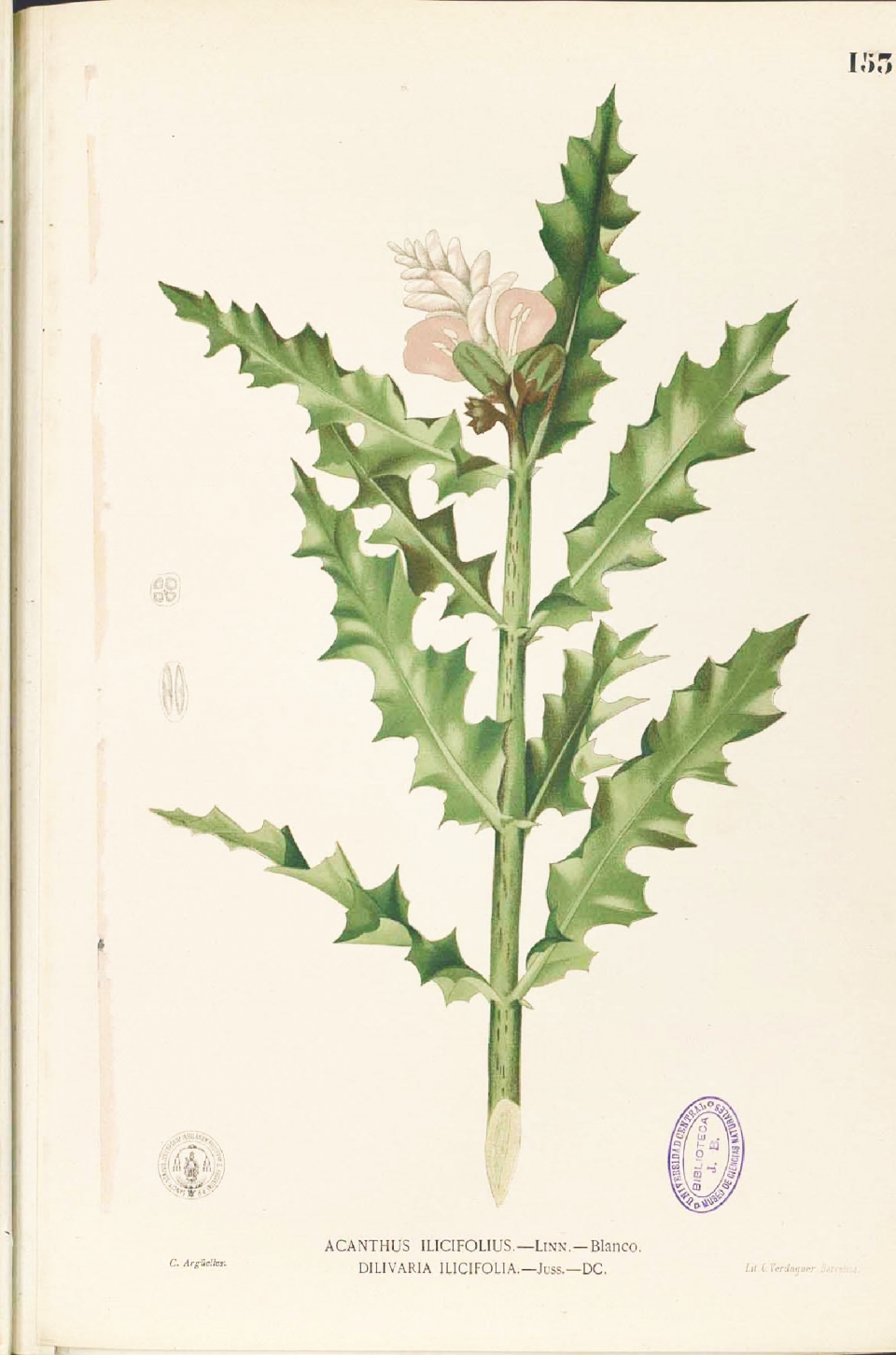
(Syn: Acanthus doloarin Blanco; Acanthus ilicifolius var. subinteger Nees; Acanthus neoguineensis Engl.; Dilivaria ilicifolia (L.) Juss.);VERNACULAR NAMES
Sanskrit: HarikusaEnglish: holy leafed acanthus , Holy Mangrove, Sea Holly
Hindi: Hargoza
Urdu: هڙکت harkata
Telugu: Alasyakampa
Bengali: Harkuchkanta, Kentki
Marathi: मारांडी Marandi, Nivagur
Konkani: Moramdo
Oriya: Harkamcli
Tamil: Kaludaimulli
Malayalam: ചുള്ളി chulli, ചുള്ളിക്കണ്ടൽ chullikkantal, പയിങ്ങാച്ചുള്ളി Payinachhulli
Kannada: Mulluchulli
Japanese: Akansasu irikiforiusu.
Chinese: Lao shu le.
French: Feuille Saintes dAcanthe
German: Stechpalmenblättrige Bärenklau
Burma: Kaya,khayat,kayoro
Sinhalese: Katu ikili, ikiri
Tulu: ತುದೆಚುಳ್ಳಿ tudechulli
Varities:
Three species of Acanthus were recorded in the mangroves of South China, including Acanthus ebracteatus Vahl, Acanthus ebracteatus var. xiamenensis (R.T.Zhang) C.Y.Wu & C.C.Hu (Deng et al. 2006.) and Acanthus ilicifolius L. However, Acanthus ebracteatus var. xiamenensis has been combined with Acanthus ilicifolius in 2008 (Hou and Lu 2008). Only Acanthus ilicifolius is recorded in the Pearl River Region.Definition
a-KANTH-us -- from the Greek ákantha (thorn); also spine or spike ... Daves Botanary
il-liss-ee-FOH-lee-us -- having leaves like a holly ... Daves Botanary
Synonyms
Synonyms in Ayurveda: artagala, argata, arttagala, bahu kanta, pradharshanaa-KANTH-us -- from the Greek ákantha (thorn); also spine or spike ... Daves Botanary
il-liss-ee-FOH-lee-us -- having leaves like a holly ... Daves Botanary
Rasa: Kashaya
Veerya: Sheetha
In traditional medicine, the plant is used in the treatment of diseases ranging from snake bite to skin diseases. Laboratory investigations on extracts of the plant have demonstrated significant pharmacological activities like antioxidant, anticarcinogenic, anti-osteporotic and hepatoprotective
Cultivation:
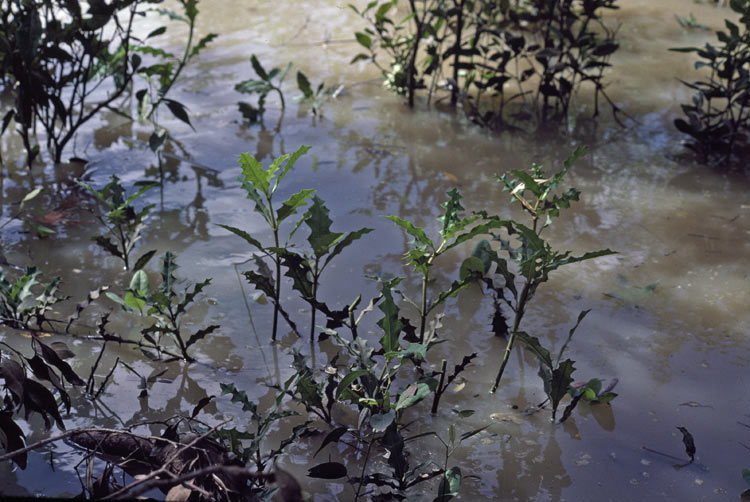
A plant of the tropics, where it is found at near the shoreline in areas with no dry season or with a short dryseason. It grows best in areas where annual daytime temperatures are within the range 18 - 26°c, but can tolerate 15 - 32°c. It prefers a mean annual rainfall in the range 1,500 - 2,500mm, but tolerates 1,000 - 3,000mmPrefers a position in full sun, tolerating some shade. Grows best in heavier soils of moderate to high fertility. Tolerant of flooding and of quite high levels of salt in the soil.Prefers a pH in the range 6.8 - 7.2, tolerating 6.5 - 7.56.
The plant sometimes forms a dense undergrowth in mangrove swamps that can be troublesome in wood-cutting operations.
The plants do not exclude salt at the root level. In fact, their sap is salty and excess salt is secreted through the leaves, to be removed by rain or wind. Sometimes, the salt can be seen as a white crystalline layer on the upper surface.
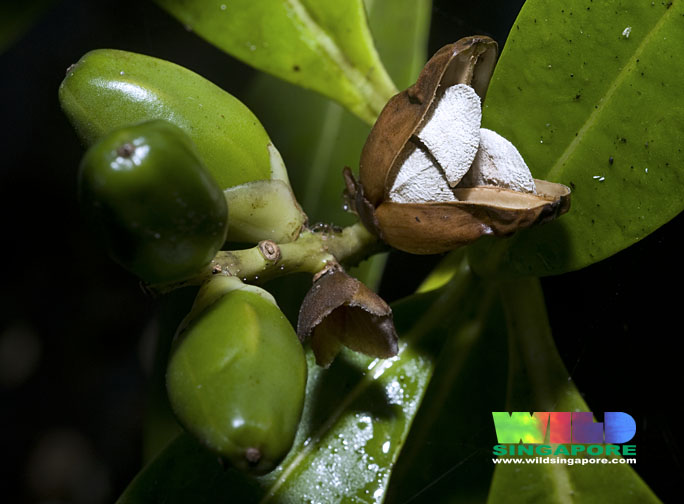
When the seedpods ripen, they open explosively to propel the seeds up to 2 metres away
Propogation:
SeedHarvesting:
Flowering: December-May
Phytochemistry:
Powdered leaves yield soft resins and a fatty matters colored with chlorophyll.
• Yields a bitter alkaloid which assumes a reddish-brown color with sulphuric acid
• Study yielded: acancifoliuside, a new coumaric acid derivative, acancifoliuside, and six known compounds: acteoside, isoacteoside, acanthaminoside, (+)-lyoniresinol 3a-O-ß-glucopyranoside, (-)-lyoniresino, and a-amyrin.
• Study of aerial parts yielded two lignan glucosides, (+)-lyoniresinol 3a-[2-(3,5-dimethoxy-4-hydroxy)-benzoyl]-O- -glucopyranoside, and dihydroxymethyl-bis(3,5-dimethoxy-4-hydroxyphenyl) tetrahydrofuran-9(or 90)-O--glucopyranoside have been isolated, together with eight known compounds.
• Study isolated a new compound, 5,11-epoxymegastigmane glucoside, along with one known compound, megastigmane glucosides, (6S, 9S)-roseoside.
• Study yielded five compounds: luteolin 7-O-beta-D-glucuronide, apigenin-7-O-beta-D-glucuronide, methylapigenin-7-O-beta-D-glucuronate, uridine, and uracil.
Parts used for medicinal purpose
Fruit, Leaves, Root, ,Dosage:
Decoction of 30-60 g of dried material used for acute and chronic hepatitis, swelling-enlargement of the liver and spleen, swelling and enlargement of the lymph nodes, gastralgia, asthma.Antidote:
Young leaves used as an antidote for snake venomControversy:
The genus Acanthus L. has almost 300 species in tropical Asia and Africa with a centre of diversity in the Mediterranean but only three species is considered as mangroves, viz., Acanthus ilicifolius L., A. ebracteatus Vahl. and A. volubilis Wall (Singh and Odaki, 2004; Duke, 2012).Commercial value:
The entire plant can also be used as a drying agent and so placed in rice sacks. It is cultivated as an ornamental plant.Morphology:
Viny shrub or tall herb, upto 1.5 m high, scarcely woody, bushy, with very dense growth
Shallow tap roots, but occasionally stilt roots are conspicuous
Leaf simple, opposite, decussate, cauline, exstipulate, petiole short, flattened, glabrous, pulvinous to sheathing base
Lamina oblong, elliptic-oblong, spiny margin and wavy, apex acute, basal angled, dorsiventral, green
Inflorescence raceme, spike, upto 16 cm long, peduncled
Flowers bracteate, curved, ovoid, entire, acute, basal cup-shaped, glabrous, greenish, two bracteoles partly covered by bracts
Flower bisexual, typically zygomorphic, complete, erect, sessile, hypogynous,
Sepals 5, polysepalous, twisted, borad, ovate, margin folded, acute, basal curved, coriaceous, greenish , persistent
Petals 1, large, showy, violet, ovate, entire, obtuse, coriaceous, slightly fleshy, slightly curved, margin outerly folded, deciduous
Stamens 4, free filament, erect
Carpels 2, syncarpous, ovary dumbel-shaped, glabrous, terete, ovary superior, two chambered, two ovules in each chamber, axile placentation
Styel 1, terminal, persistent, terete, glabrous
Stigma two bifid.
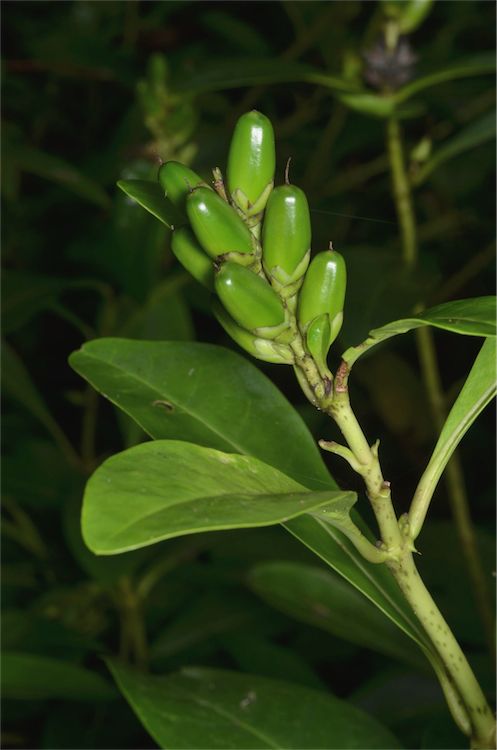
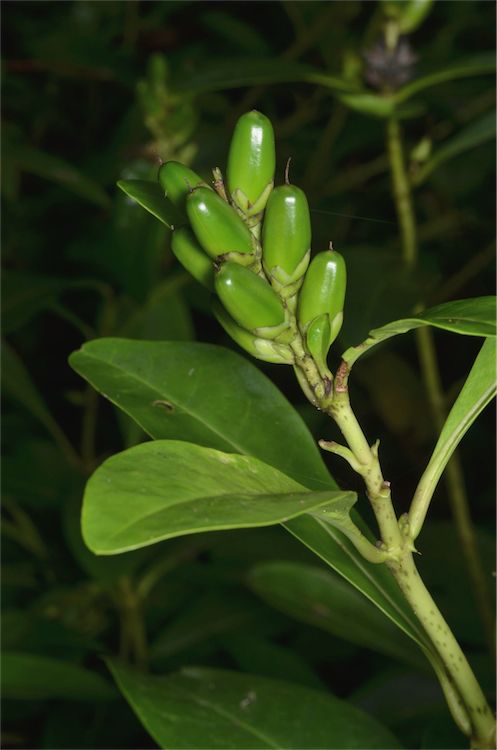
Fruit 1 cm green and 2.5 - 2.0 cm long, kidney shaped 4 seed drupe, Seed 0.5 - 1.0 cm long
Histology:
Anatomy of leaves described as dorsiventral, leaves showing adaxial and abaxial barrel shaped epidermal cells with thick cuticle. Salt glands present in adaxial side. Each gland have stalk cell and head comprising of variable number of cells. Median vein showed numerous bundles with irregular nature. The whole bundle do not shows a continuous sheath of sclerenchyma. Median vein somewhat paw shaped consists of wide parenchymatous central portion. The lateral vein bundles were somewhat near to the median bundle showing continuous layer of sclerenchyma sheath. The hypodermis is composed of two layers of colourless, polygonal shaped cells below the adaxial epidermal cells. The stomata were confined on abaxial side only. The palisade tissue was two layers in thickness. Vascular bundles collateral. Micro anatomy showed ridges and furrow like appearance in the outer surface. Epidermal cells were straight, glandular trichomes and stomata intermittently seen in the abaxial region. Stomata deeply sunken. Anatomy of stem with one layered thick epidermis. Cortex multilayered with compactly arranged parenchymatous cells. Outer cortex with collenchymas cells and inner cortex consist of parenchyma with air cavities. Growth rings are indistinct therefore classified under diffuse porous wood. Vessels are small to medium sized, even very numerous solitary and round to angular in outline. Vessel lines are indistinct. Vessel cylindrical in nature with alternate inter- vessel pitting and simple perforation plate. Rays were biseriate, homogenous and moderately broad to fine. Xylem showed spiral and annular, helical thickening. Solitary sclereids scattered in the cortex that was seen around phloem cells. Central parenchymatous pith with sclereids and tannin cells. Pith was very large with compactly arranged parenchymatous cells.
Transverse section of fruit anatomy outer cuticle outer cortex consists of sclerieds followed by chlorophyllated polygonal shaped parenchyma cells. Inner portion consists of sclerieds with a groove were present in centre. Tracheids present in inner cortex.
Geographical distribution:
Range Description: Widespread from South India and Sri Lanka to Indochina, Indonesia, the Philippines and northern Australia, but scarce in Malaysia. Common in the mangroves of south China (i.e. Pearl River Delta, China). Countries - Native: Australia; Bangladesh; Cambodia; China; Hong Kong; India; Indonesia; Macao; Malaysia; Pakistan; Papua New Guinea; Singapore; Sri Lanka; Taiwan, Province of China; Timor-Leste; Viet Nam
ECOLOGICAL ASPECT:
: It commonly grows on the river banks or tidal canal sides or low swampy areas in the mangrove forests and its vicinity.Plant conservation:
Least ConcernGeneral Use:
The root is expectorant and febrifuge. It is used in the treatment of chronic fevers, coughs, asthma and paralysis
When boiled in milk, it is largely used in the treatment of leucorrhoea and general debility
A paste of the root combined with ginger is eaten as a treatment for colic and stitch in the side
Applied topically, the leaves are used as a poultice on wounds, rheumatic joints and areas of neuralgic pain. The roots are chewed and laid on wounds caused by poison arrows; combined with a little ginger, they are ground and used as a poultice on swollen legs
Therapeutic Uses:
Cooling, mildly salt-tasting.
• Antiphlogistic, anticontusion, expectorant.
• Galactagogue, expectorant, carminative.
• Leaves considered emollient.
• Root is expectorant.
• Astringent; makes a good nervine tonic and stimulant.
Systemic Use:
Decoction of 30-60 g of dried material used for acute and chronic hepatitis, swelling-enlargement of the liver and spleen, swelling and enlargement of the lymph nodes, gastralgia, asthma.
- Decoction of roots and leaves used for asthma; also, to aid expectoration.
- Root boiled in milk used for leucorrhea and general debility.
- Used for gastrointestinal pains.
Administration:
Applied topically, the leaves are used as a poultice on wounds, rheumatic joints and areas of neuralgic pain[Pharmacological:
The aerial parts of the plant are rich in mucous and are considered to be astringent, diuretic, emollient, expectorant, resolvent, stimulant and nervineClinical trials:
1. The Gastroprotective Role of Acanthus ilicifolius - A Study to Unravel the Underlying Mechanism of Anti-Ulcer Activity / Mani Senthil Kumar KT1, Puia Z, Samanta SK, Barik R, Dutta A, Gorain B, Roy DK, Adhikari D, Karmakar S, Sen T. / Sci Pharm. 2012 Sep;80(3):701-17. Epub 2012 Jun 18.
2. Phytochemical and pharmacological potential of Acanthus ilicifolius / Dharya Singh and Vidhu Aeri / J Pharm Bioallied Sci. 2013 Jan-Mar; 5(1): 17–20. / doi: 10.4103/0975-7406.106557
3. ANTI-DIABETIC ACTIVITY OF ACANTHUS ILICIFOLIUS ROOT EXTRACT IN ALLOXAN INDUCED DIABETIC RATS / G. Venkataiah*, Mohammed Ishtiaq Ahmed, D. Sudharshan Reddy, Mary Rejeena. / IAJPR. 2013; 3(11): 9007-9012
4. Effect of extract of Acanthus ilicifolius L on anti-duck hepatitis B virus and protection of liver / Z. C. Xie, P.-H. Wei, X.-M. Mu, S.-Z. Wu, Y. Yang, S.-M. Xu, B. Qin / Topic: Virology and viral infections (Non-HIV), Abstract No: ISE.216
Research:
1. ANTINOCICEPTIVE ACTIVITY OF METHANOLIC EXTRACT OF ACANTHUS ILICIFOLIUS LINN. LEAVES / Mohammed Amirul ISLAM, Mohammed SAIFUZZAMAN, Firoj AHMED, Mohammed Mustafizur RAHMAN, Nazneen A. SULTANA, Kamrun NAHER / Turk J. Pharm. Sci. 9 (1), 51-60, 2012
2. ANTIMICROBIAL ACTIVITY OF EXTRACTS OF ACANTHUS ILICIFOLIUS EXTRACTED FROM THE MANGROVES OF KARWAR COAST KARNATAKA / Pradeep V. Khajure∗ and J.L. Rathod / Recent Research in Science and Technology 2010, 2(6): 98-99
Toxicity studies:
None known
Use in other system of medicine:
Folkloric
- Decoction of 30-60 g of dried material used for acute and chronic hepatitis, swelling-enlargement of the liver and spleen, swelling and enlargement of the lymph nodes, gastralgia, asthma.
- Decoction of roots and leaves used for asthma; also, to aid expectoration.
- Root boiled in milk used for leucorrhea and general debility.
- Used for gastrointestinal pains.
- Leaves are high in mucilage and used as emollient fomentation in rheumatism.
- Young leaves used as an antidote for snake venom.
- In India, popularly used for its wound healing effects; tender shoots and leaves used for snake bites.
- In Malaysia, leaves used for rheumatism, neuralgia, and poison arrow wounds.
- In Thailand, decoction of whole plant used for kidney stones.
- In Goa, mucilaginous leaves used as emollient in rheumatism and neuralgia.
- Ground fresh bark is used as antiseptic.
- Decoction of leaves for pain and as blood purifier.
- In Ayurvedic medicine, it is one of 9 plants in the drug Sahachara, used for rheumatic complaints.
- Plant decoction with sugar candy and cumin used for dyspepsia with acid eructations. Also used as diuretic and cure for dropsy and bilious swellings. Leaves used for snake bites, and roots used for asthma and as expectorant. Plant boiled in milk used for leucorrhea and general debility.
- In Siam and Indo-China, roots used for paralysis and asthma.
Others
- Soap: Plant is used in the manufacture of soap; the lye prepared from the ash.
CONCLUSION:
Acanthus ilicifolius is an erect or reclining shrub growing from 50 - 200cm tall with scarcely branched stems that often produce adventitious aerial roots. The leaves have spiny edges when the plants are growing in an open position, but can be totally spineless when growing in the shmade.The plant is harvested from the wild for local use as a medicine and material for making soap.
Photos of artagala -
-

- Courtesy: http://tropical.theferns.info/plantimages/8/b/8beb83bf1a1bd34d61f69ce6784cbcfb493c911f.jpg
-
- Courtesy: http://tropical.theferns.info/plantimages/e/a/ea18c85108b1083ae079a06dffd7df6eeef7d02b.jpg
-
- Courtesy: http://tropical.theferns.info/plantimages/6/a/6a00d10545cef86d1c4a669bf0df841acbde68c5.jpg
-
- Courtesy: http://tropical.theferns.info/plantimages/c/2/c26a86420bb32e1940c5b4f448c35517a07bcfda.jpg
-

- Courtesy: http://tropical.theferns.info/plantimages/b/8/b8cca36a66c021c1548f175bc03b0837168fbd9c.jpg
-
- Courtesy: http://tropical.theferns.info/plantimages/4/9/4948cc70a82cdfac1a5af0dad0f8ce07ecb1522b.jpg
-

- Courtesy: http://tropical.theferns.info/plantimages/3/9/393f1cf3b454e32439344c124bdebf298ab2d19b.jpg
-

- Courtesy: http://tropical.theferns.info/plantimages/8/b/8beb83bf1a1bd34d61f69ce6784cbcfb493c911f.jpg
-
- Courtesy: http://tropical.theferns.info/plantimages/e/a/ea18c85108b1083ae079a06dffd7df6eeef7d02b.jpg
- » Classification and names of artagala
- » Synonyms and definitions of artagala
- » Drug Properties of artagala
- » Chemical Constituents of artagala
- » Standardization of artagala
- » Parts used and Dosage of artagala
- » Morphology and Histology of artagala
- » Distribution and Conservation of artagala
- » Cultivation of artagala
- » artagala in the market
- » Medicinal Uses of artagala
- » Researches and clinical trails of artagala
- » artagala in other sytems of medicine
- » Ayurvedic formulations with artagala
- » Images of artagala

Website Administrator
This article is incomplete. If you feel you can make a contribution, please let us know by sending email to mail@ayushvedah.com, we may consider your request. Thank you.