tvak :
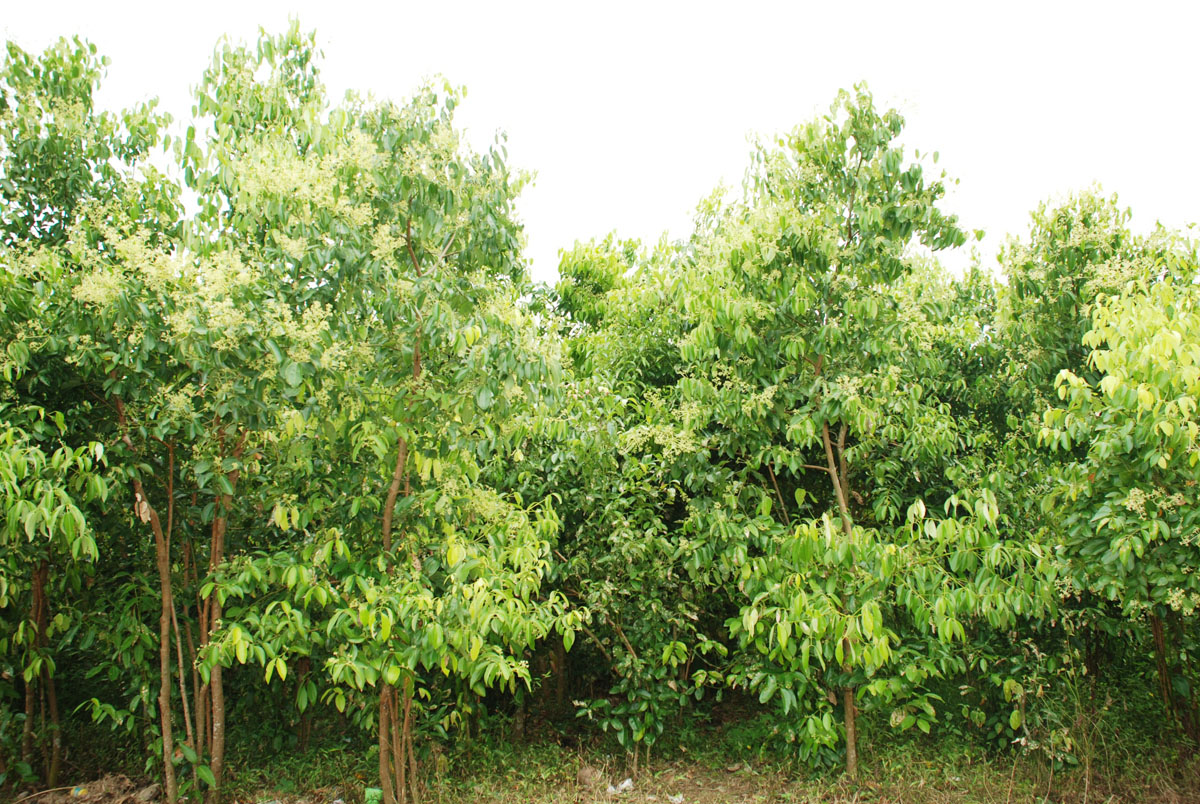
Morphology:
Bark
·
pieces about 0.5 mm thick, brittle,
·
occurs as single or double, closely packed
compound quills,
·
upto a metre or more in length and upto about 1
cm in diameter,
·
outer surface, dull yellowish-brown, marked with
pale wavy longitudinal lines with occasional small scars or holes,
·
inner surface darker in colour, striated with
longitudinally elongated reticulation, fracture, splintery, free from all but
traces of cork,
·
odour, fragrant, taste, sweet, aromatic with
sensation of warmth.
Histology:
Transverse section of bark (devoid
of cork and cortex)
·
shows except at certain places pericyclic
sclerenchyma,
·
3 or 4
rows of isodiametric cells,
·
sometimes tangentially elongated,
·
inner and
radial walls often being thicker than the outer,
·
some containing starch grains,
·
small groups of pericylic fibres embedded at
intervals in the sclerenchyma,
·
phloem of tangential bands of sieve tissue
alternating with parenchyma, and containing axially elongated secreting cells
containing volatile oil or mucilage, phloem fibres with very thick walls, upto
30 µ in diameter, isolated or in short tangential rows, sieve tubes narrow with
transverse sieve plates, collapsed in outer periphery,
·
medullary rays of isodiametric cells, mostly 2
cells wide, cortical parenchyma and medullary rays containing small starch
grains mostly below 10 µ in diameter,
·
minute acicular crystals of calcium oxalate
present.
- » Classification and names of tvak
- » Synonyms and definitions of tvak
- » Drug Properties of tvak
- » Chemical Constituents of tvak
- » Standardization of tvak
- » Parts used and Dosage of tvak
- » Morphology and Histology of tvak
- » Distribution and Conservation of tvak
- » Cultivation of tvak
- » tvak in the market
- » Medicinal Uses of tvak
- » Researches and clinical trails of tvak
- » tvak in other sytems of medicine
- » Ayurvedic formulations with tvak
- » Images of tvak

Website Administrator
This article is incomplete. If you feel you can make a contribution, please let us know by sending email to mail@ayushvedah.com, we may consider your request. Thank you.